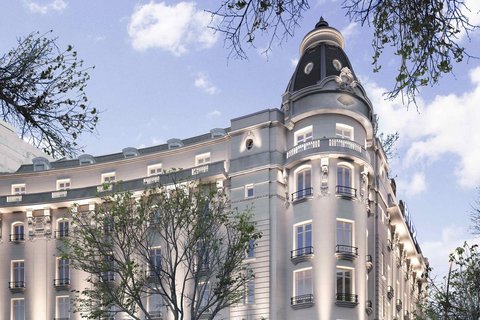
- How is this hotel positioned?
- Madrid’s enduring grande dame, the property predates most of today’s luxury competition and still anchors the capital’s ceremonial hospitality. Under Mandarin Oriental it reads as a heritage landmark paired with a global service culture, not a generic city five-star. Locally it sits among the few addresses that combine national monument status with museum-district presence; internationally it belongs to the small circle of century-old European palace hotels tied to the Ritz name and to Charles Mewes’s Paris lineage. Recent recognition as a three-key hotel reflects restored ambition to compete on gastronomy and experience, not only on nostalgia.
- What makes this hotel distinctive?
- Identity rests on being Spain’s first purpose-built luxury hotel, opened for a royal court that wanted Paris-level standards. The 2021 reopening recovered the Palm Court’s lost glass canopy and added wellness for the first time, reframing a social institution as a culinary destination. Quique Dacosta’s oversight gives the dining portfolio a single creative voice rare in hotel groups. Specialty suites and top-floor turret rooms tie guest stays to Madrid’s art and history rather than to interchangeable luxury minimalism.
- What is the hotel's setting like?
- Plaza de la Lealtad places the hotel between the Prado and Retiro, in the so-called Golden Triangle of Art rather than in Madrid’s busiest retail core. The immediate mood is stately and residential: neoclassical squares, embassy-scale buildings, and short walks to major museums. The hotel’s own garden and terrace dining soften the urban formality and offer a green pause before or after gallery visits. Upper rooms and select suites turn the Prado’s façade into part of the view, which shapes the stay as culture-first city living.
- What defines the hotel's design and atmosphere?
- Charles Mewes, architect of the Paris Ritz, shaped the original neobaroque palace with French lines and a landmark curved façade; Spanish architects Luis de Landecho and Lorenzo Gallego executed one of Madrid’s early reinforced-concrete structures. Rafael de La-Hoz led the historical restoration after 2021, while Gilles and Boissier refreshed interiors in a calm, residential palette that deliberately blurs new and original fabric. Recovering the Palm Court’s central glass roof was the defining architectural gesture, reopening the Belle Époque winter garden logic and daylight to the social heart of the house.
- What defines the accommodation, dining and wellness experience?
- Guestrooms and suites aim at quiet, apartment-like comfort after the public rooms’ opulence; several one-off suites echo Madrid’s cultural connections. Dining is built around destination meals rather than convenience: Deessa in the Alfonso XIII salon offers dual tasting-menu narratives and garden service in season, while Palm Court carries the ritual of tea and refined all-day dining under the restored canopy. El Jardín extends Mediterranean ease outdoors. Wellness is intimate and urban: an indoor pool and fitness space new to the Ritz story, with spa care aligned to Mandarin Oriental’s program and local partner expertise rather than a sprawling resort circuit.
- Who is this hotel best suited to, and for what occasions?
- Best matched to travelers who want Madrid’s museum mile on foot and a sense of occasion at the hotel itself: opening nights, anniversaries, formal entertaining, and long weekend art itineraries. Food-focused guests who treat Deessa or Palm Court as reasons to stay will find the strongest fit. Business and diplomatic visitors benefit from a discreet, central address with ballroom heritage. It suits guests who appreciate palace scale and history; those seeking stark contemporary design, large resort spas, or a nightlife-led neighborhood may prefer newer Madrid luxury options.