Le Meurice
Weather: 4°C / 40°F – clear sky
Time: 16:25 / Sunrise: 08:15 / Sunset: 17:00
228 Rue de Rivoli, 1st Arrondissement, 75001 Paris
USD 1,600


Highlights
General
| Hotel Brand | Dorchester Collection |
| Accolades | Three MICHELIN Keys 2026, Forbes Five-Star, Two MICHELIN Stars |
| Opening Year | 1815 |
| Last Renovation Year | 2020 |
| Floors | 7 |
Accommodations
| Total Rooms | 160 |
| Guest Rooms | 120 |
| Suites | 40 |
| Minimum Room Area | 30 m² / 323 ft² |
| Maximum Room Area | 620 m² / 6674 ft² |
| Maximum Indoor Room Area | 320 m² / 3444 ft² |
| Maximum Outdoor Room Area | 300 m² / 3229 ft² |
Leisure
| Spa Area | 370 m² / 3983 ft² |
| Treatment Areas | 4 |
Dining
| Restaurants | 2 |
| Total MICHELIN Stars | 2 |
Features
About this hotel
- How is this hotel positioned?
- Le Meurice sits among Paris's few government recognized palace hotels, yet its character leans artistic and intellectual rather than purely aristocratic or fashion driven. Rooted beside the Tuileries since the 1835 move to rue de Rivoli, it has long welcomed royalty, writers, and painters, giving it a salon like place in the capital's luxury map. On the Right Bank museum axis, it rivals peers such as the Ritz and Plaza Athénée through landmark views, formal service, and an unusually deep culinary identity. For international guests, it reads as a cultured, central Paris address backed by a global ultra luxury operator, suited to travelers who want heritage, civility, and serious gastronomy in one stay.
- What makes this hotel distinctive?
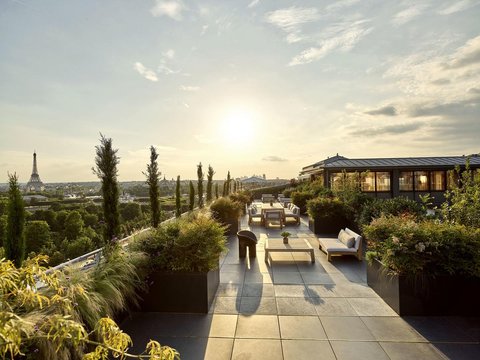
- The hotel's enduring distinction is how palace etiquette and creative irreverence coexist. Salvador Dalí's long residency left a visible thread in surrealist leaning public rooms and the Philippe Starck designed Le Dalí restaurant. Food culture is multi voiced rather than singular: Alain Ducasse's refined dining room, Cédric Grolet's sculptural pastries and sought after tea ritual, and Bar 228's jazz led atmosphere. The phased suite renewal reframed guest floors around sweeping city vistas, with the Belle Etoile penthouse and its landscaped terrace as the most dramatic expression of living above the historic core.
- What is the hotel's setting like?
- The setting is quintessential central Paris: the arcaded rue de Rivoli, the Tuileries Gardens directly opposite, and the Louvre within a short walk. Guests inhabit the ceremonial heart of the first arrondissement, where formal gardens, museum facades, and the axis toward Place de la Concorde shape the rhythm of the day. It is a district of promenades, exhibition visits, and elegant shopping rather than village quiet. Street energy is part of the trade off, while park and skyline facing rooms turn the surroundings into a composed panorama of domes, avenues, and monuments.
- What defines the hotel's design and atmosphere?
- The building's story moves from 1835 neo classical ambitions associated with Percier and Fontaine to early 20th century expansion unified by Henri Paul Nénot, when modern comforts first matched rival palace hotels. Interiors have long favored Louis XVI grandeur in salons, with brocade, marble, and gilt. Philippe Starck's work from 2007 reimagined Le Dalí and key public spaces around Dalí's playful spirit, including Ara Starck's ceiling mural. The 2020 renewal led by Lally and Berger, alongside Charles Jouffre's textile atelier, brightened rooms and suites with lighter palettes, French fabrics, chevron parquet, and bespoke furniture inspired by contemporary Parisian town house craft.
- What defines the accommodation, dining and wellness experience?
- Guest quarters are being restored as luminous, fabric rich rooms oriented toward major landmarks, with the grandest expression on the top floor penthouse and its private terrace. Dining contrasts Ducasse's formal French haute cuisine salon with the more relaxed, artistically charged Le Dalí for seasonal plates and Grolet driven pastry moments throughout the day. Bar 228 remains a discreet, leather clad meeting point with live jazz. La Maison Valmont pairs a compact spa with a beauty boutique, complementing gym, sauna, and steam facilities. The experience is defined by layered French craft across sleep, gastronomy, and wellbeing rather than resort scale leisure.
- Who is this hotel best suited to, and for what occasions?
- It fits culture first visitors who want a prestigious base for museums, gardens, and central sightseeing, including couples marking anniversaries, multigenerational trips, and small groups attending nearby institutions or events. Gastronomic travelers drawn to Michelin starred dining, afternoon tea, or a pastry focused detour will find the strongest alignment. The ornate salons and event spaces suit weddings, gala evenings, and milestone celebrations. It is less ideal for guests seeking a quiet residential neighborhood or starkly minimalist design. Those comfortable with formal service and a historic, artistic mood will feel most at home.
Key Facts
Three MICHELIN Keys 2026 Three MICHELIN Keys 2025