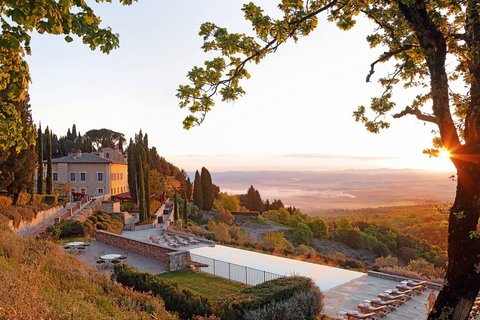
- How is this hotel positioned?
- Castiglion del Bosco reads less as a Montalcino town hotel and more as a large, privately scaled country estate opened to guests: a Ferragamo family restoration now under Rosewood, distinguished from typical Brunello lodging by its landholding, wild woodland and on-site winery heritage as a founding consortium member. Within southern Tuscany it belongs among the few addresses that offer a full working landscape rather than a scenic annex to a village. Internationally it sits with Rosewood’s place-led resorts and credential-heavy European wine stays, yet the pairing of an inhabited medieval borgo, estate golf and active viticulture remains rare even in Italy’s crowded luxury tier.
- What makes this hotel distinctive?
- Identity here is anchored in a thousand-year-old borgo with castle, chapel and Lorenzetti-era fresco, set within mostly uncultivated hills rather than a compact resort footprint. The same stay can combine Capanna vineyard education, Tom Weiskopf’s contour-following private golf and trattoria-style meals in a former village priest’s house. Eleven villas rebuilt from historic farmhouses, each with private pool and estate vehicle access, reinforce the sense of borrowing a Tuscan home. Rosewood service layers onto Ferragamo-era collecting and artisan restoration without replacing the estate’s agrarian and sporting spine.
- What is the hotel's setting like?
- The property lies northwest of Montalcino in UNESCO Val d’Orcia, where rolling clay ridges, vine rows and holm-oak forest frame long views toward the hill town. Immediate surroundings feel like a private park: trails through ruins, meadows and vineyard blocks replace formal resort grounds. Woodland buffers the vines and adds seclusion, while seasonal harvest and olive work mark time more clearly than any urban rhythm. For guests, the setting favors slow movement, open horizons and wine-country silence broken mainly by birdsong and farm activity.
- What defines the hotel's design and atmosphere?
- Carlo Ludovico Poccianti and Viva Engineering guided the architectural restoration of stone borgo fabric; EDSA shaped the landscape. Teresa Bürgisser led interiors, working with co-founder Chiara Ferragamo on antiques and art; early borgo rooms also involved Florence studio Hispano-Suiza. The 2021 Borgo extension added nineteen suites with burgundy stone, terracotta, salvaged beams and bespoke leather minibars, plus a semi-Olympic heated infinity pool over the Orcia valley. Osteria La Canonica was refreshed in the same phase. The atmosphere is earthy Tuscan eclecticism: patina, craft and discreet technology held within historic massing.
- What defines the accommodation, dining and wellness experience?
- Lodging splits between generous borgo suites with beams, terraces and pergolas, and freestanding villas where private pools, gardens and in-villa dining deepen seclusion. Ristorante Campo del Drago, led by executive chef Matteo Temperini, pursues a polished Tuscan arc built from estate garden produce and local suppliers; Osteria La Canonica keeps village trattoria warmth. The spa draws on Florentine apothecary tradition and olive-focused rituals, with forest bathing linking treatments to woodland. Pools, tennis, riding and cooking classes extend the stay beyond the treatment room into the estate itself.
- Who is this hotel best suited to, and for what occasions?
- Best matched to unhurried week-long Tuscany stays: multigenerational groups in connected suites or multi-bedroom villas, wine-focused couples, and golfers who want a course woven into the view. Honeymoons, milestone birthdays and small chapel weddings fit the borgo scale and pastoral backdrop. It suits travellers who will use a estate vehicle, join harvest or truffle outings, or base Palio-era trips from a quiet address. Less aligned with guests seeking nightly town nightlife, compact urban luxury or a purely urban spa weekend without outdoor immersion.