- How is this hotel positioned?
- Amansara sits at the quiet, residential end of Siem Reap's upper-tier hospitality: an ultra-small Aman estate shaped around repeated Angkor visits rather than downtown scale or nightlife. Where grand city hotels trade on landmark lobbies and social energy, it competes on walled privacy, cultural depth and a club-like guest count. In Aman's wider Asian circuit it pairs naturally with heritage-focused sister properties in Indochina, attracting travelers who already choose the brand for discretion and context-rich travel. Its profile aligns with internationally audited luxury peers, yet the on-ground identity remains firmly Cambodian and archaeology-led.
- What makes this hotel distinctive?
- Meaningful separation comes from royal guesthouse provenance and faithful New Khmer architecture rather than a generic resort template. Temple life is woven into the stay through house remorks, resident guides and tailored circuits that extend to remote sites, forest paths, spiritual ceremonies and village-based meals inside the park landscape. Half the suites add private plunge-pool courtyards within a two-dozen-key footprint, keeping encounters rare. That combination of state heritage, guided Angkor access and residential pacing is uncommon among larger Siem Reap competitors and defines the house experience.
- What is the hotel's setting like?
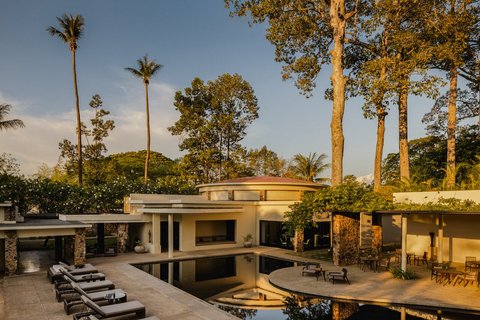
- The estate occupies the corridor between Siem Reap town and the Angkor Archaeological Park, close enough for repeated dawn runs to the temples yet buffered from the city's commercial bustle. A compact, walled garden enclave of lawns, pools and low pavilions reads as suburban calm rather than urban spectacle. The mood is cultural threshold: sandstone monuments and forest trails by morning, shaded courtyards, spa stillness or slow countryside drives when heat and crowds build. Surroundings emphasize continuity with Khmer heritage landscapes over shopping or entertainment districts.
- What defines the hotel's design and atmosphere?
- French architect Laurent Mondet conceived the 1962 royal villa as New Khmer Architecture: single-storey white volumes, stone accents, colonnades and climate-aware openness. Aman's early 2000s restoration, led by Kerry Hill Architects with Ross Logie as project architect, preserved those forms while extending the compound and adding courtyard suites with plunge pools. Enduring signatures are the curvilinear main pool and the circular dining rotunda with its soaring ceiling and terrace. Interiors pair terrazzo and timber with restrained, mid-century clarity, yielding a hushed, gallery-like atmosphere rooted in 1960s state modernism.
- What defines the accommodation, dining and wellness experience?
- The stay is organized as generous open-plan suites opening to light-filled courtyards, with private plunge pools on half the keys for post-temple recovery without leaving the room. Dining concentrates in the landmark rotunda and seasonal roof gatherings, framed by Khmer and international cooking, village-house breakfasts in the park and hands-on classes that tie food to place. Wellness favors calm over spectacle: a modest spa beside an old rain tree and reflection pond, Khmer-informed treatments, steam, movement options and a lap pool. An unhurried rhythm of included meals supports long heritage days.
- Who is this hotel best suited to, and for what occasions?
- Best matched to culture-focused couples, design-minded travelers and small families who want expert Angkor interpretation rather than independent sightseeing. Multi-night stays suit first visits and return journeys deepening knowledge of remote temples, crafts and rural life. It fits thoughtful honeymoons, milestone travel and Aman-led Indochina routes linked with Luang Prabang. Less ideal for guests needing large resort infrastructure, lively nightlife or anonymous city-hotel anonymity. Occasions centered on education, gentle adventure and recovery after temple days align most naturally with the property.